Medical product development is changing, with growing interest in technologies that can provide more relevant human models without relying solely on animal testing.
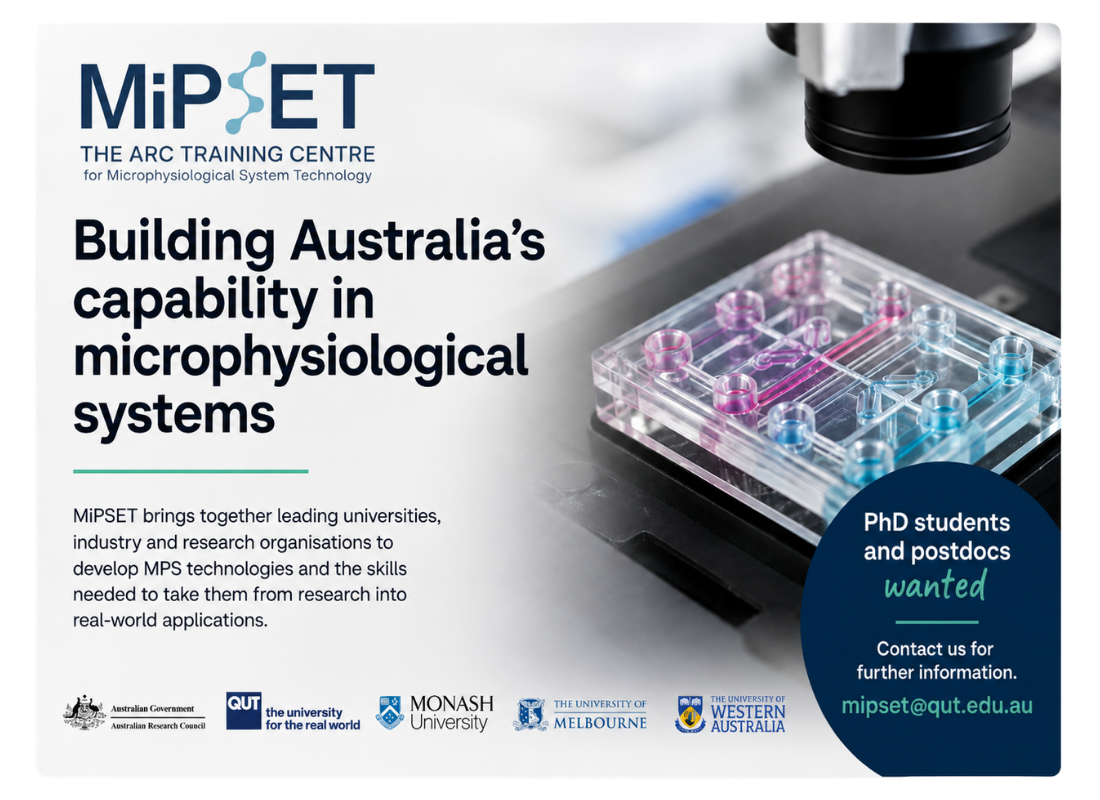
Microphysiological systems (MPS) are one of the technologies being developed to meet this need. MPS use engineered platforms containing human cells, tissues or organoids to replicate aspects of human physiology and disease.
The ARC Training Centre for Microphysiological System Technology (MiPSET) has been established to help build Australia’s capability in this emerging field.
Led by QUT, MiPSET brings together QUT, the University of Melbourne, Monash University and the University of Western Australia, alongside industry and research partners, to develop MPS technologies and the skills needed to take them from research into practical applications.
The Centre has three main areas of focus: developing new MPS technologies, improving how they can be manufactured and scaled, and developing the sensors and data capabilities needed to measure and validate them.
Training is equally important. MiPSET will support researchers and industry personnel to develop specialist MPS skills while gaining an understanding of the broader technology pipeline, from innovation through to translation and deployment.
The aim is not simply to develop new laboratory models. It is to build the research capability, industry connections and workforce needed for MPS technologies to be developed, tested and adopted in Australia.
MiPSET brings these different parts of the field together, creating a national centre focused on the development, validation and translation of MPS technology.
Join the MiPSET team
MiPSET is currently recruiting PhD students and postdoctoral researchers to join the Centre and contribute to the development of next-generation MPS technologies.
Interested in joining us? Contact MiPSET for further information about current opportunities: mipset@qut.edu.au