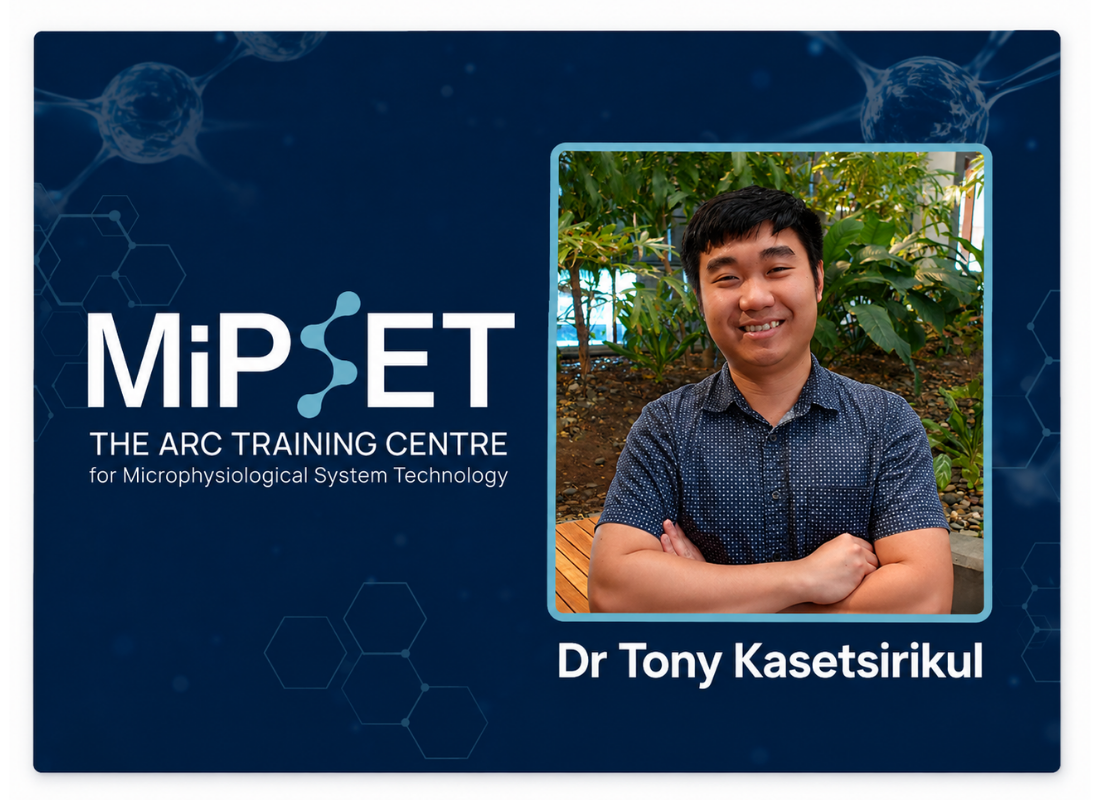
For Postdoctoral Research Fellow Dr Tony Kasetsirikul, that is one of the problems worth solving.
Tony's research at QUT focuses on integrating biosensors into microphysiological systems (MPS) and organ-on-chip technologies. He combines biosensing, microfluidics, tissue engineering and 3D printing to develop models that more closely replicate aspects of human tissue.
A major challenge is monitoring the health and function of these models over time. Conventional methods often require researchers to take samples or stop an experiment to see what is happening.
Tony is working on an alternative: building sensors directly into the MPS so biological changes can be monitored continuously. "Many of the methods currently used to assess tissue health and function are invasive, require sampling, and only provide snapshots of what is happening at a single point in time," he says.
With integrated biosensors, researchers can track biological signals as they change, rather than relying only on measurements taken at the end of an experiment. Tony is also interested in how the resulting data can be analysed to provide a clearer picture of tissue behaviour and physiology.
The work brings together several areas Tony has worked across during his career, including microfluidics, paper-based diagnostics, biosensors, additive manufacturing and tissue engineering. He is also exploring 3D printing as a way to rapidly prototype and customise organ-on-chip devices.
MPS brings all these areas together to address important biomedical challenges.
Dr Tony Kasetsirikul
For Tony, that combination is one of the reasons MPS research is so interesting.
Being part of the ARC Training Centre for Microphysiological System Technology (MiPSET) means Tony can work with researchers across QUT, the University of Melbourne, Monash University, and the University of Western Australia, as well as industry partners working on different parts of the MPS technology pipeline.
He hopes the work will contribute to MPS platforms that can give researchers better information about disease, drug responses, and tissue behaviour, while making the technology more practical for wider use.
MPS research matters because it helps us create human-relevant models that better predict how our bodies respond to diseases and treatments, accelerating the development of safer and more effective therapies.
Dr Tony Kasetsirikul
MiPSET is currently recruiting PhD students and postdoctoral researchers to work across the Centre's research programs on important work like Tony's.
Interested in joining us?
Contact the MiPSET team for further information about current opportunities.
Contact MiPSET