Program 1 – MPS Design & Innovation
PROGRAM 2

Why This Matters

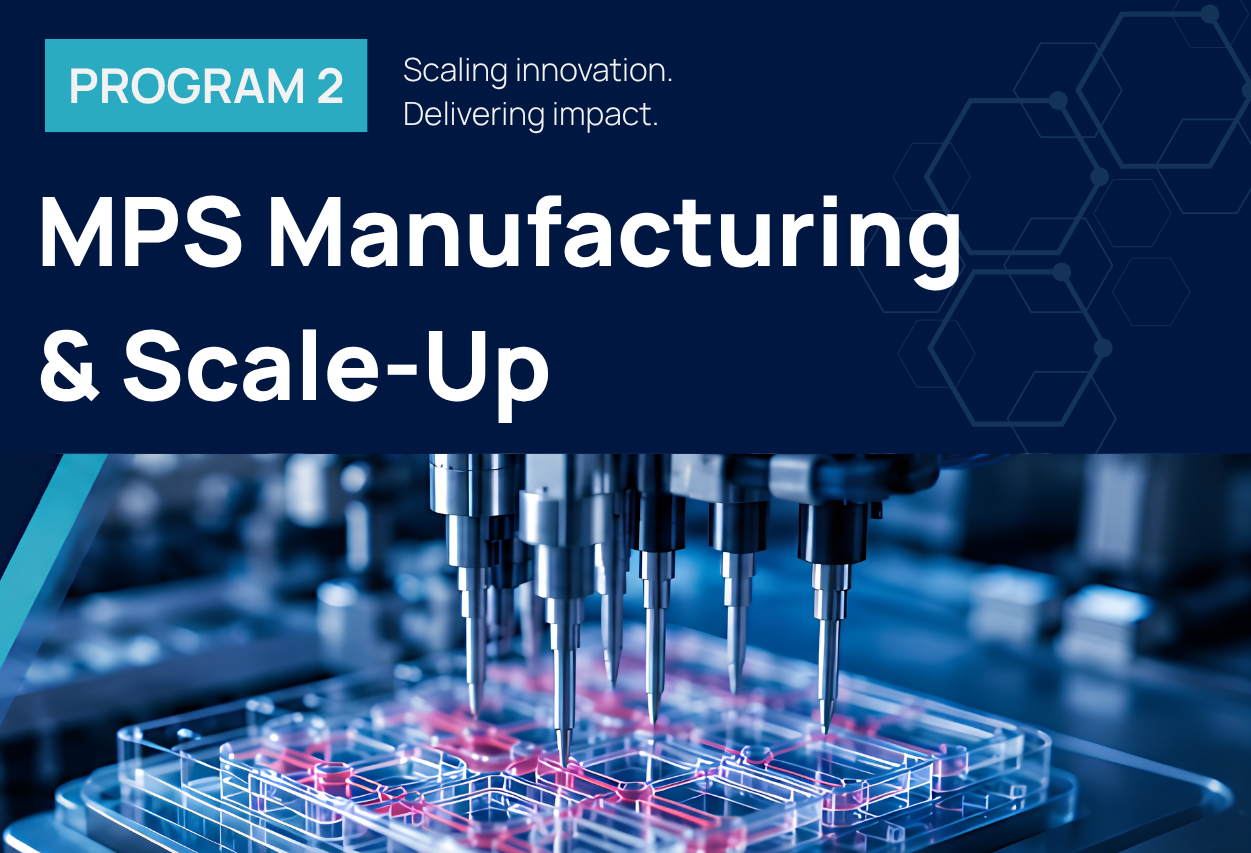
Program 2 – MPS Manufacturing & Scale-Up

Many promising microphysiological systems (MPS) fail to progress beyond the laboratory because end users need confidence that they can reliably predict human responses and fit within existing drug development workflows. To achieve that, we need robust, scalable approaches for manufacturing and operating MPS that can be readily integrated into existing drug development workflows.

MiPSET's Manufacturing & Scale-Up Program addresses these challenges by developing manufacturing-compatible MPS technologies and scalable production processes from the outset. Through advances in additive manufacturing, automation, biomaterials and tissue engineering, the program is creating the tools and workflows needed to transform research prototypes into robust, reproducible technologies that can be produced, deployed and adopted by end-users.

WHAT WE ARE EXPLORING

Research Questions

01

How can light-based 3D printing technologies be optimised to fabricate microfluidic MPS devices with resolution, biological compatibility, and throughput suitable for industrial manufacturing?

02

What new polymer surface engineering and post-processing techniques enable 3D-printed photoresists to support long-term, viable cell culture?

03

How do we design open microfluidic devices that support multi-organ cultures while remaining compatible with standard multi-well plate robotics and automated pipetting systems?

04

What strategies allow consistent, scalable generation of human tissue components (organoids, bioengineered tissues) for MPS production?

OUTCOMES

Potential Impact

01

Manufacturing-compatible MPS enabled by advanced 3D printing technologies, improving the precision, reproducibility and scalability of MPS devices from research prototype to deployable product.

02

Automation-compatible platforms that integrate with existing pharmaceutical robotics, liquid handling and screening workflows.

03

More reliable production of organoids and engineered tissues, helping overcome a major bottleneck in biomedical research and drug development.

04

New opportunities for Australian industry in biomedical manufacturing, biomaterials, automation and medical device production.

PEOPLE IN THIS PROGRAM

Researchers and Investigators

PROGRAM LEAD
Prof Alastair Stewart

Prof Alastair Stewart

Program Lead / Deputy Director

University of Melbourne

A/Prof Nathalie Bock

A/Prof Nathalie Bock

CI – Biomimetic Bone/Tumour Models

QUT

Distinguished Prof Dietmar Hutmacher

Distinguished Prof Dietmar Hutmacher

CI – Tissue Engineering & Biofabrication

QUT

Prof Yi-Chin Toh

Prof Yi-Chin Toh

CI

QUT

Prof Laurence Meagher

Prof Laurence Meagher

CI – Polymers & Materials

Monash University

A/Prof Victor Cadarso Busto

A/Prof Victor Cadarso Busto

CI – Micro/Nanotechnologies

Monash University

A/Prof David Collins

A/Prof David Collins

CI – Microsystems Engineering & Bioprinting

University of Melbourne

JOIN OUR MAILING LIST

Stay up to date with the latest MiPSET news, research, events and opportunities.

Scroll to Top